
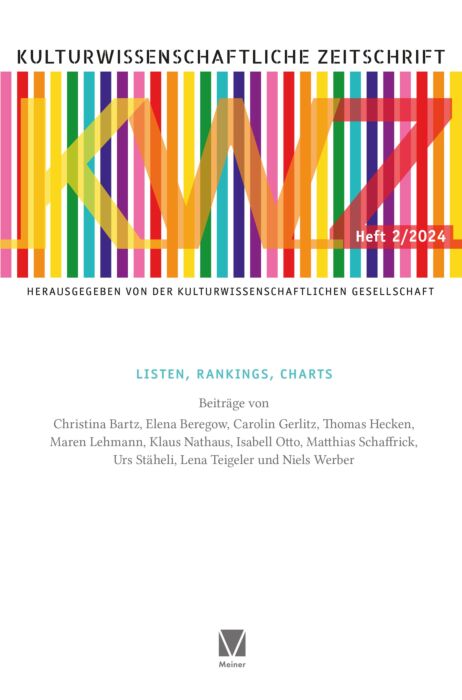
Listen, Rankings, Charts

Zur Behauptung des Populären

Wird geladen …
Ab: 0,00 €

Beschreibung

Bibliographische Angaben

Reihe
Herausgeber/in Thomas Hecken Niels Werber
Beiträge von Christina Bartz Elena Beregow Carolin Gerlitz Thomas Hecken Maren Lehmann Klaus Nathaus Isabell Otto Matthias Schaffrick Urs Stäheli Lena Teigeler Niels Werber Werber. Niels
Hersteller nach GPSR
Felix Meiner Verlag GmbH
Richardstraße 47
D-22081 Hamburg
Telefon: +49 (40) 29 87 56‑0
Fax: +49 (40) 29 87 56‑20
E-Mail: info@meiner.de

Einzelartikel als PDF

The article explains what is meant by ›ranked lists of the popular‹. ›List‹ is used here as a generic term. Rankings of the popular are, among other things, those representations that include the quantitatively determined data of voting records of very many people who are not identified as experts. Examples of such popular rankings include the results of political elections, opinion polls,music charts, book bestseller lists and trending topics. Such lists make a decisive contribution to the assertion of the popular. In this respect, the popular is conceptualized in a different way than in many current theories of popular culture, in which the quantitative dimension plays a lesser role. In the second part, the article looks at previous researchoncharts, rankings and lists and examineswhether their results can be used to assess the rankings of the popular.
The subject of the article is the IKEA catalogue and the product lists it contains. It analyses their structure and design and discusses three theses. 1) Following consumer culture research, it can be argued that the lists promisea general variety of products. 2. The arrangement within the lists suggests a selection by comparison. 3. The IKEA catalogue advertises the popularity of its own products. One the one hand popularity means sales success and on the other hand suitability for consumersʼ households.
This article traces the affective structure of Spotify playlists. In contrast to classical music charts on the one hand and mixtapes and ›alternative critics‹ charts on the other, Spotify playlists are analyzed in terms of their affective structure regards authority, valuation, circulation and the status of users and things. Borrowing the concept of ›affective practice‹ (Margaret Wetherell), I capture the interplay of everyday listening practices with the algorithmʼsmodes of operation. The Spotify charts are then used to show what status the charts have within the platform, and how they are getting competition frommood playlists which implement affect on the platform interface. Finally, the ›algorithmic imaginaries‹ (Taina Bucher) in which the algorithm is figurated by users as an affective, evaluative instance are sketched out. The article argues that a new relationship between lists and popularity develops within the Spotify universe: Lists do not simply claim popularity, lists themselves become popular. In this way, an internal platformcompetition of lists qua circulation emerges, in which Spotify charts become increasingly challenged by personalized, mood and genre playlists.
The order of inclusion in modern society regulates an imperative without any exception. Therefore it is based on a reverse complementarity: It is determined by an asymmetry of expectations dominated by the role of the layperson, the client, the customer, or the audience, but not by the role of the professional actor. These laypersons, clients, customers, or audiences are addressed as generalized counterparts without any particular self-description or self-understanding; on their side of the asymmetry, there is no clear identity. Thus, quantification spreads, which is assumed to be the only medium to describe this indescribable, especially since it is the classic mode of describing the incomprehensible, poorly integrated, foreign, nameless and worthless. The article first examines the sociological traces of this assumption. It then considers lists, ratings, and rankings as diagrammatic forms of quantified complementarity, following the idea that visualization might be a mode of inclusion in quantified contexts. Quantification manages and organizes inclusion without presupposed group affiliations ormemberships and yet serves as resource of affirmation in the context of contingent social relations.
This article studies the function of popularity charts in the production and distribution of popular music in the United States during the first half of the twentieth century. Using archival sources of Irving Berlin’s music company to gain insight into how a leading songwriter and music publisher made repertoire decisions in the face of uncertain demand, the article argues that the charts did not reflect to music providers what the people would buy tomorrow but helped coordinating their actions with other actors across the music business. Against a sketch of song-plugging on Tin Pan Alley, the article traces the rise of the airplay charts in 1930s radio, the establishment of the Peatman-Index as industry standard in 1945, and its demise by record charts from the mid-1950s. Doubts about the veracity of quantified popularity and critique of chart manipulation were a constant feature of this development, and yet, music providers like Berlin continued to use them for guidance. This illustrates that self-referential charts may create facts that limit listeners’ choices, while not impeding on recipients’ ability to making their own meaning of what is being offered to them.
Since September 2023 Billboard has been working with ByteDance’s global short video platform to determine the »TikTok Billboard Top 50« on a weekly basis. This new chart from the established entertainment magazine presents the current music trends on the platform, which has grown rapidly in recent times, based on video productions, views and other measurable user engagement. This ranking not only shows a change in the music industry, which is experiencing a surge in popularization through the appropriation and mashup practices of social media users. It also shows how ›second-order popularization‹ and thus the production of the popular based on rankings and charts is changingunder the conditions of digitallynetworkedplatforms. The following article examines the extent to which the influence of meme practices on the metrics of popularization reveals a new way of asserting popularity, for which, in addition to the quantifiable attention of the many, the inherent dynamics of practices are decisive. In a first step, the relationship between pop music and TikTok is analyzed. Secondly, there is a case study of a TikTok dance trend that emerges from pop cultural transfers from the Netflix series Wednesday and brings a sped-up version of the song »Bloody Mary« from2011 into the charts twelve years later. A third section uses further examples to shed light on how rankings on TikTok themselves function as meme templates and in turn produce new practices of evaluating popularity. Returning from the case studies material, a fourth section concludes by reflecting on the new development of observing viral and meme-generating social media songs in the standardized metrics of the popular culture music industry.
The current popularity paradoxes of the book market (book enthusiasm on digital platforms on the one hand, decline in book sales on the other) are best illustrated by bestseller lists. To this end, the article conceptualizes bestseller lists as a medium of second-order popularization in contrast to other evaluation practices in the literary field that engage in first-order popularization (e.g. literary prizes). Based on theoretical approaches and empirical findings, the article shows how bestseller lists are modified in order to react to the continuous depopularization of the book and the competition from digital platforms such as Amazon and TikTok. It thus argues for a literary sociology of the popular.
The paper discusses different types of fragrance lists and their importance in contributing to olfactory popularity. While sales-based best-seller lists are crucial, they remain hidden from consumers unlike other areas of popular culture. Instead, social media lists based on indicators such as views have become important for the public perception of perfumery, creating a shift from sales figures to often viral social media communication. These lists are complemented by ›subjective‹ lists created by influencers and perfumistas, such as ›compliment getter‹, ›expert‹ and ›iconic‹ lists. The paper examines these lists in terms of the everyday life of perfumes and how they address the material olfactory dimension of success. The interplay between these different types of lists demonstrates hints at competing and interwoven ideas of popularity. The paper demonstrates that the classic high/low distinction, which originated in luxury perfumery, continues todominate an olfactory understanding of popularity, in contrast to a purely quantitative approach.
The assertion that our society is ›complex‹ is hardly disputed. From this complexity of society, actors face the ›contingency‹ of their possibilities for action. Because social order offers a multitude of possible connections between elements, no action is strictly necessary; alternative options are always conceivable. This contingency is restrained in functional systems by symbolically generalized media of communication (sensu Parsons, Luhmann): money, power, or truth motivate the preference for certain selections – because money is paid, because the exercise of power should be avoided, or because one trusts and builds upon the findings of research. Thus, media amplify selectivity and increase the connectivity of a certain communication. The essay pursues the thesis that rankings function as amplifiers of selectivity. For the top positions in rankings, the chances increase that the corresponding products, individuals, parties, or programs will receive attention and can play a role in subsequent communication. In a society shaped by rankings, the social distribution of attention, therefore, follows more a logic of popularity than a logic of substance.
Lists are essential elements of social media platforms: Lists of popular topics, accounts, followers, likes, clicks, views, search results or feeds provide orientation, structure our attention and guide practices of content reception and production. Content, they suggest, is particularly relevant when it is noticed by many, shared by many, commented by many. At the same time, researchers employ platform data and create lists themselves to approach issues, users or platform dynamics. The platforms’ logic of the many has inscribed itself in empirical platform research. Thereby, perspectives that move beyond the top users, the most used hashtags, the most shared URLs or the most active accounts are increasingly receding into the background. Inspired by discussions in data feminism (D’Ignazio/Klein 2020), we develop an alternative approach to Twitter/X data that questions how the platform aggregates diverse user activity into extrapolations of the many, by focusing on data that is not prominently displayed by the platform itself or even made invisible. We explore how platform data can be utilized to intervene into the data driven organizational logic of the platform itself.

Mehr aus "Kulturwissenschaftliche Zeitschrift"

Pop und Populismus in den Unterhaltungsmagazinen um 1933
Erscheinungsjahr (Copyright): 2025
Umfang: 156
Ab ca. 0,00 €
9783787351343
Erscheinungsjahr (Copyright): 2025
Umfang: 160
Ab ca. 0,00 €
9783787350483
Erscheinungsjahr (Copyright): 2025
Umfang: ca. 190 Seiten
Ab ca. 0,00 €
9783787347193
Erscheinungsjahr (Copyright): 2025
Umfang: 211
Ab ca. 0,00 €
9783787348770
Erscheinungsjahr (Copyright): 2024
Umfang: 134
Ab ca. 0,00 €
9783787349807
Erscheinungsjahr (Copyright): 2024
Umfang: 114 Seiten
Ab ca. 0,00 €
9783787346561
Erscheinungsjahr (Copyright): 2023
Umfang: 195
Ab ca. 0,00 €
9783787346578
Erscheinungsjahr (Copyright): 2023
Umfang: 209 Seiten
Ab ca. 0,00 €